Download the APP here for free
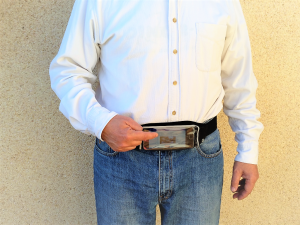
Smartphone belt bag (example)
Questions and comments: info@balancedgait.com
General Information
What is Balanced Gait Test?
Balanced Gait Test is a gait analysis system based on the smartphone’s built-in accelerometers. It automatically identifies the phases of the gait cycle and calculates 16 parameters that describe gait symmetry and homogeneity.
It also provides the Balance Degree, a global score from 0 to 100 that summarizes overall gait balance.
How does it work?
- The user places the smartphone at the waist, secured with a belt pouch or waistband.
- They walk naturally for a few seconds.
- The app records accelerations on all three axes and automatically detects the gait cycles.
- The system analyzes step symmetry, homogeneity, cadence, and power.
- The report is displayed on screen and can be sent to the therapist.
Analyzable Parameters
- Step symmetry (duration and ax/ay/az accelerations)
- Homogeneity between consecutive steps
- Cadence (steps per minute)
- Power generated during the test
- Balance Degree (0–100)
Clinical Applications
Neurology
- Assessment in Parkinson’s disease, Alzheimer’s disease, multiple sclerosis, neuropathies, and stroke.
- Gait variability is a relevant indicator of neuromuscular status.
Traumatology
Monitoring of knee injuries (ACL, meniscus), hip or knee prostheses, and tibia/ankle fractures.
Geriatrics
Assessment of frailty, fall-risk evaluation, and monitoring of walking stability in older adults.
Rehabilitation and Physiotherapy
Objective monitoring of therapeutic progress and comparison between sessions.
Measurements can be performed in a real-world environment, not only in clinical settings.
How to perform a test
Preparation
- Place the phone firmly at the waist using a belt pouch.
- Find a straight, unobstructed area to walk comfortably.
- The user should walk naturally and avoid talking during the test.
Procedure
- Place the patient in front of a clear, straight, and flat area where they can comfortably walk at least 20 steps. Although it may slightly affect the result, it is acceptable for the patient to turn around and walk the corridor twice.
- Secure the belt pouch with the phone firmly attached to the body, centered, and with the screen upright facing forward (see photo).
- Explain that they should walk naturally at a comfortable speed.
- Press the ⊕ button and then Start.
- Wait for the sound cue to begin walking (check the phone’s sound settings if necessary).
- The Test ends with a second sound once the programmed number of steps has been recorded.
Report contents
- Balance Degree
- Acceleration export (premium version)
- Graphical summary (premium version)
- The 16 symmetry and homogeneity parameters (premium version)
- Option to send results to the therapist (premium version)
Practical details
Experiment with the instrument
Try performing tests using your own walking pattern. In the first trials, you may hold the phone in your hands, although this can worsen the results by preventing natural arm swing.
Get a phone holder
To use the instrument correctly, the phone must be firmly secured at the waist using a holder. It should be as centered and upright, facing forward, as possible.
Several suitable holders are commercially available. Here is an example.
Professional use
If you are a therapist interested in using Balanced Gait Test professionally, you can register in the Private Area.
The Private Area is free and offers tools that make it easier to manage your patients’ test results.
With Balanced Gait, it is possible to monitor patients’ progress remotely.
The patient can perform the Test using their own phone and upload the data to the therapist’s Private Area.
Frequently Asked Questions
Is the smartphone measurement reliable?
Yes. Modern smartphone accelerometers provide high-resolution data.
The algorithm is designed to accurately identify support and swing phases of the gait cycle.
What does the Balance Degree measure?
It is the average of 16 gait parameters, normalized to a 0–100 scale.
It summarizes overall gait balance in one global value.
Can the test be done at home?
Yes. Patients can perform the test themselves and send the results to their therapist through the Private Area.